I’m a certified Nutritional Therapy Practitioner, hold a Master of Public Health in Behavior Change, and am a Master Certified Health Education Specialist with a background in crisis intervention.
Despite all that training, I lived with binge eating disorder for over 16 years. My binge eating eventually escalated into full-blown food addiction, which lasted for over four years.
My training helped me understand the science. Living it showed me how dark and consuming binge eating can become, how alone it can make you feel, and how badly the usual advice can miss what is actually happening. I know what it is like to fight food noise all day, fear what would happen if I ate one cookie, and promise myself that each binge would be the last.
Together, my professional training and lived experience became the foundation of Healthanie’s 1% Safer Framework. I built the framework I desperately needed.
Hi, I’m Stephanie

When food thoughts are constant, urges feel urgent, and you are using all your energy trying not to binge, you do not yet have space for deep inner work.
In that state, understanding why it is happening is not enough. You need relief from the binge fire first.
That is why we begin by quieting the food noise, reducing the urgency, and giving you practical ways to interrupt the cycle in real time.
Then we rebuild. We go deeper into the nervous system, the reward pathway, and the underlying patterns and behaviors keeping the cycle active. We also shape your environment to make bingeing less likely and new responses easier to repeat. You are not only stopping a binge in the moment. You are actively changing what keeps bringing the cycle back.
At the center of my work is one premise:
You cannot rebuild the house before you put out the fire.
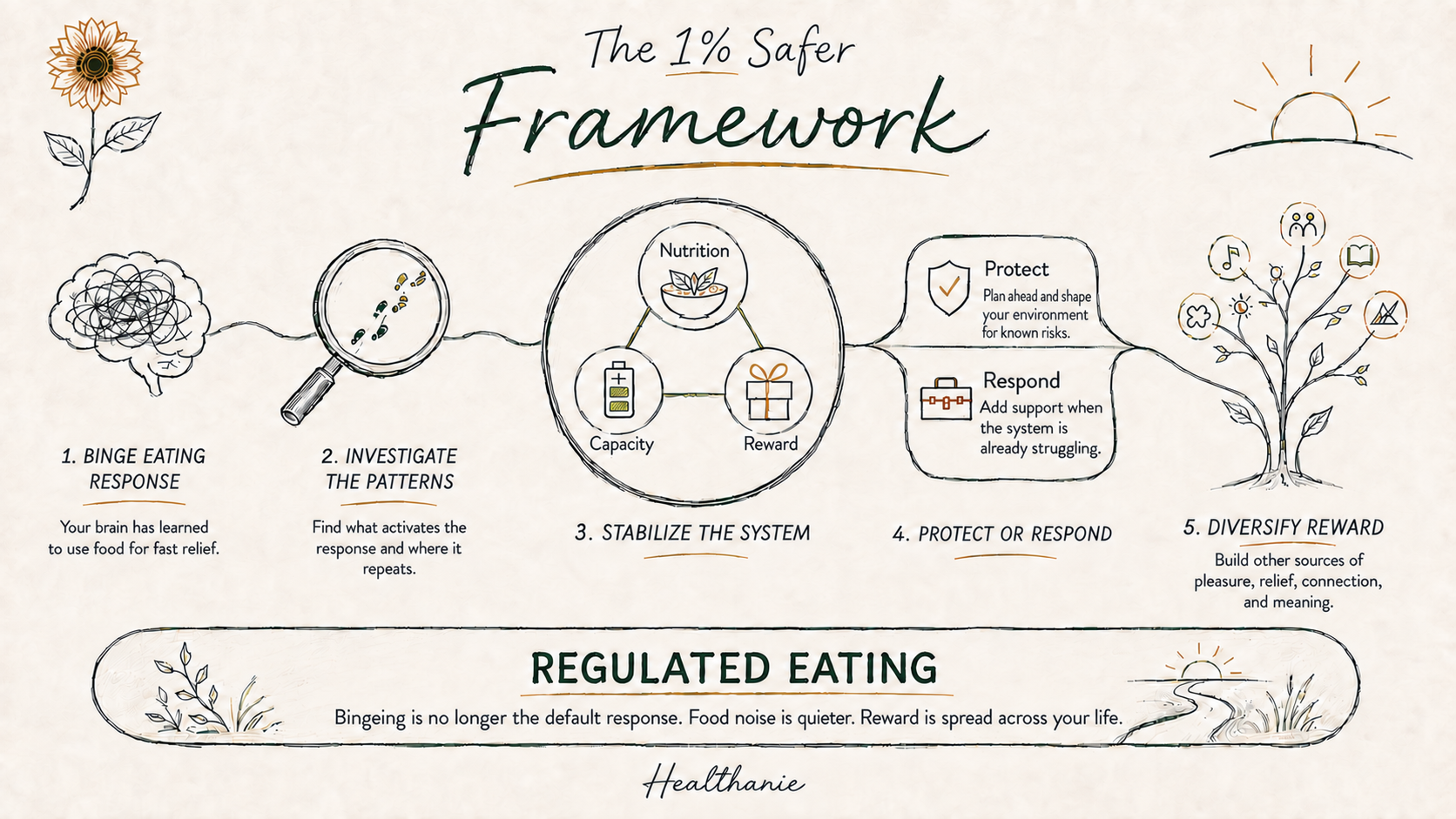
The 1% Safer Framework
Stabilization within the framework focuses on three supports: nutrition, nervous system capacity, and the reward pathway (your dopamine response system).
We look at how the way you are eating may be intensifying your urges, how stress or overstimulation affects your ability to interrupt them, and how your brain has learned to use food for quick relief or reward.
Those clues help you understand what keeps the cycle going, recognize risk earlier, protect yourself before a binge, and know how to respond when the urge is already there.
The work
-
Healthanie and 1% Safer support thoughtful, capable people who feel out of control around food. Food thoughts feel constant. Binge eating feels compulsive.
You may have no idea why this keeps happening. Or you may recognize the pattern afterward and still feel unable to interrupt it when the urge hits. This work meets you in either place. Together, we uncover what is driving the urgency, map your patterns, and practice new responses until they become easier to access in real time.
-
Nutritional therapy is an individualized approach that uses food, nutrients, lifestyle support, education, and practical tools to help eating feel more stable and less compulsive. It is capacity-based, meaning we work with what your brain and body can realistically manage right now.
The primary work is stabilization. We look at the factors that can make food feel more magnetic, food thoughts more obsessive, and urges harder to interrupt, including blood sugar patterns, stress response, dopamine and reward learning, and nervous system load.
This is the put-out-the-fire part of the work. By giving the brain and body more consistent support, we create the capacity to investigate patterns, respond to urges, and build steadier eating.
-
Safety
Creating stability and reducing risk before asking for deeper change.Curiosity
Investigating patterns without judgment and treating each binge as information.Freedom
Building more choice around food and more sources of pleasure, relief, connection, and meaning.